Showing posts with label Parenting Philosophies. Show all posts

Monday, December 26, 2011

Please, make a mess! It's good for you!

I am a believer in messes. I believe that messes and developing creativity and imagination go hand in hand. I think that children learn best though exploration. I firmly agree with experts that allowing a child to make a mess is developmentally important. Don't get me wrong though, I also really enjoy a clean and tidy house! Getting my hands yucky at all kinda freaks me out to the point that, for example, I refuse to touch dirty dishes without kitchen gloves. I also have to "suck it up" for Ty's sake in some situations if I need to demonstrate or if he invites me to join in. If he sees me modeling mess-averse behaviors, he's likely to pick up these habits himself. I truly do enjoy watching him really get into things though! There's just too much for him to miss out on if I didn't let him go at it full throttle.

If your child doesn't enjoy getting messy, head to the end of this post for sine tips that my help your little one ease into it!


Below you can see the creativity that unleashed itself in the first fifteen minutes of a painting session. While I introduced painting with balloons, the rest was discovered on his own:

: Balloon paint & hand prints,
Leaning over to make "belly prints"
Tray of paint on the head & painting "blind".

If I were to stop him, it would disrupt the flow of learning. As I watch him put paint in his hair, I know that he is creating quite a sensory experience for himself. As he shakes an enormous amount of edible glitter all over a Christmas cookie, I know that he will learn in a moment when he tips the cookie, that it won't all stick. Eventually he will figure out why, or perhaps I casually sneak in a bit of knowledge.

This isn't anything that soap and water can't handle!
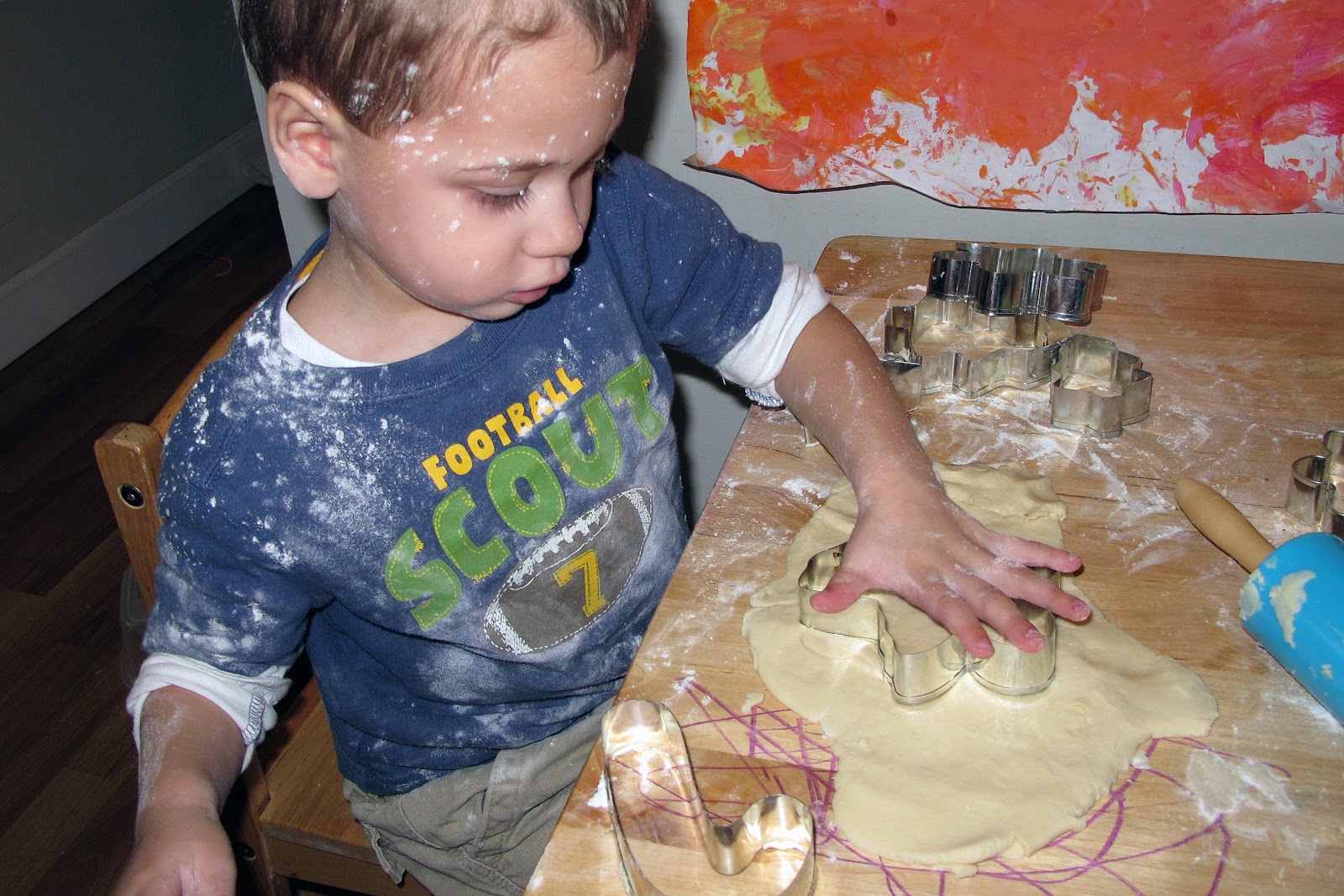
In order for us to both be comfortable, we create messes in a place where I'm not concerned about potential stains or difficulty in cleaning. For us, this place in the kitchen or outdoors. I buy washable, non-toxic paints and materials just in case. I supervise to make sure he's safe, i.e. no large amounts of water or paint on the floor to slip on.

There's so much to  learn about mixing colours, consistency and texture... So many motor skills to refine...


To me, it's always worth it worth five to ten minutes of cleaning for the typical half an hour or longer session of discovery. I have learned to cover the table with an old sheet. I know to have everything for the bath ready just in case. Ty has been quickly trained on how to walk with his hands help up in front of his chest on the way to the tub to keep it off of the walls (though if he "failed" at that, it wouldn't be a big deal anyhow).

These cookies aren't only full of sugar and shortening, they're also full of toddler pride and pleasure!

I tend to give Ty an array of things to create with so that he can do whatever he is feeling, and to experiment in many ways in one messy session. I walk around the house and sift through closets looking for random items that may be interesting and use old standbys and your typical tools as well. He may choose one thing to use, he may use them all. Each time it leads to finding out something new.

Messy play, art in general, baking, and play dough often are known stress relievers. They're typically calming because you get caught in the flow of the moment. It quite possible put yourself in a meditative state without even realizing it. I know this of myself and believe it's true for Tyler as well. So many times when engrossed in this type of play he barely realizes I'm in the room, and I keep rather quiet to allow that focus and state of being to develop.

In our home, we create art for arts sake, not for an end product.  


If you can't even see the bottom of your tub, you know you and your little one have done an extra great job!

If this entire post seems useless to you because your child doesn't like to get messy, there are other ways to let them explore, and rest assured that many children break out of their mess-hating status eventually. Believe it or not, Tyler went through stages where he felt that Mama trying to get him to finger paint or touch wet sand was downright abusive! The key is to never force a child or make them feel weird about their aversion, but to ease them into activities slowly, respecting their qualms.

You can try squish bags for a mess-aversive child, using shaving cream, ketchup or hair gel.

Your child can try marble painting, which is fun art made by putting paper inside a box or tray with paint and marbles. Tipping the box will allow the marble to paint for them!

Give your child a brush to use instead of finger painting. Get some paint on your own hand and show them how it washes off. If the child is still unsure, providing plastic gloves is an option as well! Be sure to provide a smock or old t-shirt if they're scared of getting their clothes messy.

Providing bath paints may be a good option for some children as they are already in the water and can be readily cleaned off. Bingo Markers/Paint Markers are also fun and can be used with little to no mess on paper. I've also heard that Color Wonder finger paints have worked well for some children!

Wednesday, September 28, 2011

"A Person's a Person, No Matter How Small"

Though this blog is typically about activities and the Montessori, I woke early this morning and out of nowhere began writing post in my head. These are my opinions, and as an imperfect parent, I'm not here to judge. I did however wish to share my reflections, what I've learned, and what I believe.

Responding to Children's Fears

Tyler has recently become scared of several of his stuffed animals. After removing five stuffed animals in the last two days, I understand that when he's staring across the room saying "Oh no! Help, help Mama! Bye Bye!" it's time to figure out which animal needs to disappear. Since he was a baby, Tyler has shown fear of a few random stuffed animals and animal pictures. I'm unsure if he's recently having nightmares about some of his animals chasing him or hurting him or if he's stressed about something in his life, but lately his fear has reached a peak. I could choose to chide him and tell him that he's silly to be afraid, that they're not real, that they're just pieces of material sewn together and filled with fluff. I could call him a baby. I could even be terribly cruel and leave the animals where they are, insisting that he "get over it" and "conquer" his fear. If children's emotions and fears were somehow less real and experienced at a much lower level than those of adults, perhaps the above strategies would work...but they're not. In fact because the world is so new to children and their quantity of life experiences to take from so much less, I daresay that children's fears are felt at a greater depth than our own.


We are all afraid of something. Many of us have had the same fears for years or our entire lives without abatement because fears and phobias are difficult if not impossible to shake without intensive therapy. For me, all of the logic in the world won't make me afraid of falling out of an enclosed ferris wheel car and plummeting to my death, especially when it's stuck at the top. Someone without arachnophobia can tell me that the enormous wolf spider that was just killed next to my bed is gone so there's no reason to be afraid to sleep, but my brain can't help what it thinks or my body how it reacts. The person not afraid of spiders can "not get it" all they want, it's still my reality. So for Tyler, even if I don't understand the fear or it make absolutely no sense, I respect it. I give him the word "scared" or "afraid" to help him label his emotions. I remove the offending animal, letting him watch me stuff the frightening beast high in a closet corner. We tell it "bye bye", over and over until he seems satisfied. Now that he's older I let him show me where the animal should go and reassure him that the animal will stay there until he says it's okay for it to come out. After this little ceremony, all is well, and we move on with our day. When he's older and has more words, I will be free to listen and let him express his emotions and fears in whatever way he is experiencing them. Though I may take a brief moment to educate if needed, I will refrain from judging, no matter how "silly" it may all seem to me. I will look for ways to comfort and console without disregarding what his brain tells him is real.


"No Mom, I'm NOT okay"

As parents, one of the easiest things for us to say to our children is "it's okay" or "you're fine". We've all done it. Whether our children are upset about another child taking a toy or they fall down safely in the grass and come to us crying, we say it.. It's not that we're bad parents and don't care. We hate to hear our children cry. We want them to feel better and fast. For some reason though, we believe that an adult authority telling them that they're okay will cause the child to stop and realize that they're actually just fine and life will suddenly go on like nothing happened. Maybe we don't even think of it that way. Maybe it's just an automatic response that so many of us have learned. Even when a child hurts themselves badly, is having a painful procedure, or just experienced something traumatic, the line we choose to croon over and over to them is "you're all right, baby. It's okay", as if we say it enough times it will come true...for the child and for ourselves. Once you see how illogical these words are, when you realize that the child is their own separate being with true experiences, it's obvious that this response doesn't make sense or show compassion for our children at all.

Perhaps for some it's not about making the child instantly feel better, but about not raising a child to be a "baby" or a "whiner". Maybe it's about raising a little boy who grows up to be "tough" rather than a "sissy". For whatever reason, I imagine that all of these small children who are being soothed with "you're okay" must be screaming inside: "No, I'm not okay! I fell down and wasn't expecting it. It was scary. I'm scared! I know my knee looks fine to you but that little scrape hurts and you didn't notice my wrist twist when I landed on it. Don't you know what it's like to be hurt? Didn't you cut yourself with the knife chopping vegetables the other day when you were distracted by me? You yelled out in pain and your eyes were full of tears for several minutes! What about when you burned your hand on the stove and mentioned how much it hurt all night whenever it bumped into something? I hurt just the same as you and it's extra scary to me because it's all new. I don't understand a lot of things yet, but I do know that I'm not just fine!". Of course they're right. Unfortunately most children don't have the words or guts to express themselves in this manner. We have to be the mindful ones.


This is not to say that every time your child falls down or bumps their head you should rush over and exclaim "Oh my gosh are you okay?!" I've seen this for the most minor of accidents, and I can tell you where it leads a lot of parents...to overly dramatic children. That or kids who have to look at their parents for their reaction when they have the most minor of falls to see if they're okay, as if it's up to the parent to let them know if this is something to be worried about. Clearly it should be up for the child to decide if they need boo-boo kissing or if they can just move on and keep playing. I can tell you from years of experience with small children that unless it's a good-sized injury or a good amount blood is involved, most kids will carry on with their play...and you can let them. My husband and I make it a habit to cover our gasps with our hands or bite our lips when Tyler has an accident of some sort. If he is truly hurt, or just so tired that even the most minor incidents upset him, we offer our embrace and do our crooning, but we try hard to say things such as "Ouch! That hurt, huh?" or "Did the cat give you a boo boo? I'm sorry. That doesn't feel good and made you sad" or "I saw you fall off your bike and hurt your hand. It hurts!" rather than letting that "you're okay" line slip out of our mouths. Neither of us are perfect, but we're trying.

Having others who will respect and validate feelings, pain and experiences is something we all want in life. Our children's needs and desires are no different just because they are small. If we raise our children in this mindful manner, perhaps they will be the one to hug and console a friend petrified by a garden snake spotted while playing kickball rather than the one calling the phobic child names and chasing them around the field with the snake danging from their hands. In a society that's a bit too full of bullies and selfish behaviors, we can at least try to mold children who will model compassion and understanding for others. It has to start somewhere right?