I haven't been able to create new posts in twelve days (the others were automatic posts) but Tyler's work and passion for numbers has continued to take off during that time. Before I get into what he's doing, I want to say that he is not a typical 29 month old when it comes to this subject (or a lot of things). Most children his age will probably not be ready or interested at all in the following activities. If your child isn't here yet, they are not all behind! Every child's developmental process is different. [Toddler Early Math Milestones] It is typically a slow process for a child to learn the correlation between number quantity and it's suggested to start with a good deal of 1:1 correspondence work and the sandpaper numerals. If you'd like to see some of our favorite early math activities, you can click on the "math" tag from the subjects in the left panel of my blog to find them.
To backtrack, Tyler has had 1:1 correspondence down for some time and has understood at least how to pick three books before bed time. He knows at least eight shapes, the differences between heavy/light, big/small, long/short, can sort by size, can match objects to patterns and has recently learned to recognize numbers 1-12. He has been counting out up to eight objects in a book correctly since last summer (before he was two years old) as well as up to 12 real objects. He can stack 16 cubes or unit blocks. We have used toys such as shape puzzles, sorters, sandpaper numeral peg work, an abacus, used different sized measuring cups and spoons in sensory play and baking, and I have counted things for him and talked about numbers in a natural way since he was a baby.
As of my last post a couple weeks ago, even though he's been ill this whole time, Tyler is now counting to 29 on his own. Needing help with 30, 40, 50, 60 (as he doesn't know his tens) he counted up to 64 last night before getting bored (a similar video is shown above). He is counting backwards from 10-1, occasionally skipping 4. He is able to look at a number of objects (1-3) and know how many there are quickly. He is.understanding quantity not only with tangible things (objects) but will jump, kiss me, pat my nose or do other actions a certain number of times when given a number. He has also been showing early subtraction knowledge. If he is playing with a number of objects and we ask for one object then inquire on how many he has left, he instantly has the answer. Addition has been easy adding with one, though we haven't done more than plus one. He loves to listen to "The 12 days of Christmas" (yes, still...in January) and grab each number from his numbers puzzle as they go up. To him this is fun. It's what he likes. The following are the activities that we've done in the last couple weeks to keep his passions going!
Go Fish
Since Tyler learned his numbers and was so excited by them, I figured we would try to play "Go Fish".
Though we have a deck of cards, I wanted something with bigger numbers and less distractions for the game. I found these Thomas The Train flashcards in the dollar section at Target and purchased two sets. We used numbers 1-6 the first time and I only dealt four cards to myself and four cards to Tyler so he would have less to keep track of.
My husband and I took turned helping him play. He quickly picked up on finding matches of numbers and putting them down. He needed help learning how the game works and the rules of course, but after several games he got the hang of it. My husband then had to cook lunch so I figured that would be the end of playing, but Tyler wanted more. I didn't really think it would work well, but Ty is always ready to prove me wrong lately! We played for at least half an hour.
Ty had trouble holding the cards when he had more than two, so he lay them on the floor as I kinda expected, though sometimes now he will lay them in his lap or hold them. Tyler took to asking me for certain numbers quickly, though once in a while he asked for a random cards without looking at his own. When he got a match, he asked more for more of the same number. It was cute and he didn't mind being redirected and helped a bit. He was okay with handing his cards over to me when he had them. He sure did like telling me to go fish though! He now fully understands the game and needs very little redirection other than convincing when it's time for him to "go fish". He knows he doesn't want more cards!
The only trouble I can spot with this game is that Tyler quickly recognized the correlation between the number of trains or other items on the back of the cards and the number on the other side. One of the first times we played, he grabbed a card with one train on it from the go fish pile, saying "one!". I often found him studying the backs of my cards as well. For this reason I've started to use some higher numbers so it isn't so easy for him to figure out what he's looking at, though it's good practice for him to recognize quantity too, so I do use a few lower numbers he can figure out!
If your child doesn't yet recognize numbers but knows colors, shapes or letters, you could play with those types of flashcards or make your own! I do suggest buying a true set of Go Fish cards if you're able though. Matching Numerals to Visual Quantity
Seeing that Tyler decided to learn the names of numbers 1-10 from his caterpillar puzzle, I knew I needed to get him started on the important stuff a bit more, learning quantity! We'd been using his sandpaper numeral peg boards, but I wanted to mix it up and get the concept into his brain in several different ways. This is a more visual and less "hands on" way to see that, for example "three is MORE than one or two", but it works and will be important in the future for reading a dice.
Using stickers, I made cards with either one, two or three dots on them. I also made cards with the numbers 1-3 to correspond. Tyler's work would be to match the number of dots or stars he saw on the card to the correct number.
This isn't a work that Tyler is ready to do by himself yet, mostly due to maturity. Though his likes this work, laying out cards to match to label cards isn't something he cares to do by himself. He wants me to make it a bit of a game. So, we lay out the numbers, then I gave Tyler one card at a time, asking how many dots he sees. He surprised from the first attempt by shouting out "one!" and "two" correctly right away. With three he sometimes has a bit more pause and I encourage him to count the dots if needed, though other days he's quite quick.
The only "issue" we had with this work (and I noticed it when we did heavy/light and warm/cold sorting), is that Tyler likes to cover the label or number rather than placing them above or below it, making it difficult or impossible to see where the next item may go. I decided to tape the numbers to cups so that he could put the cards inside next time. Though it's ideal to control things such as cup color (keeping everything the same except what is to be focused upon), following the child meant having to push that rule aside as I don't have three same cups or small bowls to work with! He doesn't seem too distracted. Number Work with Playing Cards
Just before he showed us that he had truly mastered recognizing 1-10 with his puzzle, I decided to get a deck of playing cards out to see if he was interested. He immediately enjoyed finding the numbers and noticing that some were red and others were black. As I sorted through to get rid of everything but the numbers, he became interested in learning the different suits. I knew I had to figure out a way for him to use the cards.
I soon decided to give him cards 1-10 in clubs (I taped over the Aces with 1's) to see if he could put them in numerical order as he does his caterpillar puzzle. He needed a bit of help with the concept and he got to six or seven before getting a bit overwhelmed and moving on to something else. He also kept getting 6 and 9 confused, even though I suggested he count the clubs. He just didn't want to take the time. I decided we would only work on putting 1-5 in order next time.
After putting them in order the next day, I then had 1-5 in hearts ready to go, and asked if he wanted to match them to the clubs by numeral. He was cool with that.
This is a work he has taken off of his shelf to do a few times, though he it isn't a favorite. I'm not sure what he does with it when I'm not around as I sometimes find it laying scattered on his rug with all of his other number works (he isn't as into putting everything back on his own as he used to be...), but something must intrigue him.
Active Numerosity Games
As mentioned near the beginning of this post, I've done a few active games with Tyler to see what he could do with numbers as well as to practice in different ways. Here are some that you may be interested in trying.
Ask your child if they can do whatever they love to a certain amount of times: Could you eat three Cheerios? Could you put two balls in the basket? Could you give me four crayons?
You can also work on intangible actions, asking: Can you stomp your feet six times? Can you give your doll two kisses? Could you pat your head four times?
While we mix it up during the day, Tyler's favorite thing to do is to jump, so I ask if he can jump a certain amount of times, usually no higher than twelve. He wants to play this game quite often! After a couple days of playing, I then added to choices, asking, for example, "Do you want to jump two times or three?" or "Do you want to jump four times or eight?". The latter game made me realize that he does know which number is higher or "more", as he almost always picks the higher number! He wants to jump as many times as possible!
Counting on our Fingers
Since becoming interested in numbers, Tyler has also wanted to be able to show a certain number with his fingers. He first wanted to count our fingers over and over and to push them down or bring them up while we said the numbers. He then started to work more on his own hands. He delighted in showing us a whole hand and saying "Five" then bringing out his other hand and telling us "ten!". Though it was tricky work at first, he is getting pretty darn good at showing numbers with his fingers, counting backwards and forwards with them. This is something he really wanted to master, so along with just helping him figure it all out, we worked more on finger plays with numbers to make it fun and get him that finger exercise to help his control. These are the songs we used:
Where is Thumbkin?
Five Little Monkeys The Crocodile Song
Five Little Ducks
Five Little Speckled Frogs
Near Future:
I now want expand upon Tyler's subtraction (it's all been very casual), understanding quantity with higher numbers, using objects to show quantity, and simple fractions. I would love to create the traditional Montessori Red Rods and Spindle Box as I cannot purchase them right now, but haven't quite figured out a very low to no cost way to do it yet that I'm happy with. Here's to hoping inspiration strikes soon!
Ty hasn't really taken the typical road to Montessori literacy, mostly because he started on the journey himself, and continues to do so. I'm trying to get him on track a bit more with traditional Montessori practices, but while following his lead as well. This has been our journey so far and where we we are today, including new activities we've started working with to further his interests. There are many videos, mostly for myself perhaps, to log Tyler's amazing (to me anyhow...I'm his mom!) progress. The majority of toddlers aren't ready or interested in what Tyler is up to and that it 100% normal, so please don't feel that you need to push your child in this (or any!) area. I've simply followed his lead.
This post became much larger than I thought it would be at the start, and I ended up separating it into the categories below. If you've been following our Montessori journey most of the year, the "old" work may be somewhat of a repeat. It also may seem odd to some that both writing and phonetic sound works are included when dealing with literacy, but in Montessori, the two go hand in hand!
Older work with phonetic sounds
New work with phonetic sounds
Writing Work
OLDER WORK WITH PHONETIC SOUNDS
At 20 months old (now 28 mos), Ty was telling me the sounds that many letters make, having never been formerly taught. This was a surprise to me. It all started when I randomly told Tyler that he was holding the letter "H" at a children's museum one day and he immediately made the /h/ sound. Over the next week I started asking him about other letters and he quickly knew twelve. For fun, the following video shows some of them:
For the next month I contemplated buying him the traditional sandpaper letters. Was he really that interested? Would this be pushing rather than joyful learning? He had the capacity to learn for sure, but did that mean he had the desire? Eventually I purchased the letters, knowing that if he didn't care about them that I would at least be wise enough to just put them away and not force anything. He would let me know.
I started Three Period Lessons with the sandpaper letters with Tyler when he was 22 months old. I made sure to educate myself on the primary sounds for each letter as they that are taught in Montessori Education, as many letters make more than one sound. [Letter names are of little importance for reading or in Montessori philosophy. If you're looking to learn the proper letter sounds, this Video by Virtual Montessori or this great lesson from Montessori Mom are quite helpful.] I tried to stick to the general order that letters are introduced, while also trying to use letter sounds that Tyler could make at that time.
Ty showed a real interest in the letters for a while and did well, then became less and less enthused. I stopped letters lessons all together for a while due to his waning curiosity and drive.
At 23 months old, Tyler fell in love with a book from the library called "Sleepy ABC's" by Margaret Wise Brown. Unfortunately the letters were uppercase, but Tyler learned what sounds went with which letter quickly. After he had showed letter sounds knowledge a few months before, I began saying letter sounds rather than the letter names in many of his books. In the video below, Tyler correctly makes the letter sounds for 17 letters, often before I even asked. Tyler has a speech delay which was quite pronounced back then (his progress the last few months has been astounding!), so it was impressive to me that he could make so many sounds accurately.
I knew that it was possible that Tyler simply had the book memorized, so I checked with other books to see if he knew the letter sounds. He was pretty accurate with those as well when he wished to show me what he knew. He isn't often one to "perform" when asked.
In September, (24 mos), after seeing so many letter trays in my favorite blogs, I hesitantly created one with the letter "b". I wasn't sure how much Ty would get out of this. I can't explain it, but it's just not the way he learns. He enjoyed the objects, but I didn't see a ton of attention paid to the fact that they all began with the same letter, so I haven't made any othres. Perhaps when he's a bit older he can help me go around the house and create his own letter basket. That seems more his style.
I also used alphabet mats with a few of the letters that look the same lower and upper case, and the corresponding sandpaper letters, together. His work was to place each letter piece into the correct mat, then match the sandpaper letter to it. I would do a quick three period lesson to be sure he remembered what each letter said beforehand. He enjoyed this! Of course the letters we could use were limited. Bummer!
Around this time, I tried Three Period Lessons again with varying success. I didn't know if it was because he already knew the letters and was bored (though I wasn't too sure about him knowing them all), if it just wasn't reaching him in the right way, or if he didn't care enough. I secretly breathed a sigh of relief at times when he had no interest in the lessons though. Since he began showing knowledge of letter sounds without being taught and at such an early age, I was a bit nervous about the Tyler and the label "hyperlexia", which often is associated with the autism spectrum. Luckily had never been obsessed with letters or reading and there's no real concern; he simply knows his stuff and picks up on these things quickly, but naturally the concern would crept into my head.
In November, Tyler became interested in an alphabet book (Leap Frog's "Animal Orchestra") that showed both lower and upper case letters for each. The book had been around for at least a yerar, though Ty never cared for it until one day when he was supposed to be picking up his toys and suddenly went for the book instead (in an atttempt to distract me...it worked). He quickly learned almost all of the letter sounds in conjunction with the letters (I forget how many exactly...22 perhaps). The day I tried to sneakily get video was the last day he wanted to read this book to me. Ever. Lesson learned.
It should be noted that while reading familiar books to Tyler that I would sometimes drag my finger below the words as I read, and while I haven't done this often, it's something I do practice more and more as his interests peaks. I started this when he was an older infant and he was interested in me reading the Cheerios box to him every morning. I tend to follow the words in familiar books with fewer words on the page, never slowing drastically or speaking in a staggered way. My only goal has been to show him that the "stuff" on the page is telling me what to say as I go along. Recently I point out words that may look familiar to him.and Tyler will sometimes drag his finger under the words himself as I read, left to right, sometimes happening to follow right along.
NEW WORK WITH PHONETIC SOUNDS
Ty's interest in letters peaked again about a month ago (but still not so much three period lessons) so I thought I'd show Ty how letters come together to form words. I had shown him this before in random situations, but I knew we could really go after it now. I demonstrated for him that changing the first letter in a certain word could make a different rhyming word. I showed him things like "cat / mat / hat / rat" and "dog / fog / log" He seemed quite intrigued, but not wildy. Whenever I asked if he wanted to work with letters he gave an excited "yeah!" and we did the work together. I then put these letters on his shelf for him to work with one his own, one rhyming set at a time. He never touched them.
Tyler now knows eleven colors easily, has had the Pink Tower and Mini Cylinders mastered for at least a month, knows about eight shapes, and can create a square and a rectangle with cubes, He has been fond of noticing and labeling sizes, taking the tiniest bite of a food he doesn't totally care for and finding the absolute biggest Christmas cookie on a tray, even in it's by the smallest hair difference. He can find a sticker that is different in line of quite similar stickers and balance a lever. This may not seem to have any relevance (and seem like bragging), but all of these activities practice the art of visual discrimination, a skill that is needed for recognizing letters and words and telling them apart. Along with Tyler's love of books and the ability to sit and listen to stories with hundreds of words on a page, it made sense that Tyler's next interest would be sight reading.
Last week, a few days before Christmas, at 28 mos, Tyler sight read aloud for the first time. As I wrote about in a recent post, I started writing the word "dog" and "cat" with Cheerios as we ate them, which Tyler became really interested in. Many times he could even tell me what sound came next as I configured each letter. After asking me to write "dog" several times at breakfast, he sat down and drew the letter "d"...then scribbled over it as he tends to do. Excited (maybe a bit too much), I wrote down his name "Tyler" as well as "dog" and "cat" on a piece of paper and gave it to him along with paper and a pencils so he could have a visual of the words in case he wanted to write them. It was way too much to expect, but you just never know with Ty, so I grabbed my video camera. Instead of catching some amazing leap in writing, I watched him scribble out each word, reading it as he scribbled out each..."Bye-bye dog, bye-bye cat, bye-bye Tyler". I didn't know he could read them until that moment! I knew I hadn't read the words aloud to him that I wrote on the paper. He truly read them! I'm amazed how calm I kept myself in the video below...I really wanted to scream in delight!
Since then he has been asking us to write the words "sun" "dog" "cat" "Tyler" and "Mama" all over the place...on his new Magna Doddle, on paper, on a steamy mirror...wherever. The interest is absolutely there.
Then, the day after Christmas, Tyler attempted to sound out his first word. He had acquired new spoons in his stocking which said "LOVE" on them, all in capital letters, though we hadn't gotten around to mentioning this fact yet. During lunch, Tyler started inspecting the mysterious word and tried to sound out each letter, left to right. While it was difficult to hear what he was saying and I don't think he was too correct with most of it, he did sound out the letter "V" correctly! He then looked up at us with a big smile! He knew that he had just attempted to do something really neat and had done one letter correctly! The fact that he recognized "Hey, this is a word...wonder if I can figure out what it says" is such a huge milestone! This, along with the sight reading, happily kicked my Montessori Mama butt (which had been taking a relaxing little holiday vacation) into high gear.
One new game that I decided to introduce to him was an "I Spy" type of game, and a rather traditional one in Montessori education. I chose several of his animal figurines (it could be any group of random objects) that made the "correct" phonetic sound, called him over and asked if he wanted to play a game. Ty almost always eager for new activities, so he ran over and sat down. I then put several of his animal figurines in front of us and said "I'm thinking of an animal that starts with /e/ (for example). Then on to the next until we had gone through all of the animals.
He understood this immediately. The second time we played I wasn't fast enough between questions and he started playing by himself, grabbing the cat, for example, and saying "/c/, cat" and putting it aside. I then grabbed more animals and we tried again, as the below video shows. I was a bit surprised at how easy this was for him and will likely start playing a letter sound hunt game, asking him to find something in the room that starts with a particular sound to make it more challenging.
What I decided to do next was to expand upon his work with the sight words he wanted us to write out for him. I drew pictures of each then wrote the words, lowercase of course, for him to match underneath each picture.
After a couple days of not being the least bit interested, he gave it a go and did great! There was real pride in his face as he matched each correctly. True Montessori would use nomenclature style cards for this activity for self-checking and correcting, which I plan to do next time I have access to a copier.
Using the Melissa and Doug Magnetic Letters that he received for Christmas, I also thought my little magnet lover may enjoy matching the magnetic letter to the written letter on his magnet board. Really, the best thing to have would be the Montessori Moveable Alphabet, especially as I'm not 100% satisfied with the appearance of some of the letters, but these will have to do for now.
That said, Tyler has had no interest in this activity so far. He wants the letters to lock-in, like a puzzle. Instead of the magnetic letters I guess I should have gone with the Melissa and Doug See and Spell puzzles. I will try this activity again soon.
WRITING WORK
Tyler went ahead of me a bit with this whole writing business, starting to draw some letters in the late spring/early summer (21-23 mos old) after watching me draw them with chalk in the driveway. He would sometimes draw "T" (for Tyler) and "H", another important letter for him. If you asked him "would you like to draw the letter "T?" he would sometimes do it, but he's also a child who knows when someone wants him to do something...and therefore won't. You often have to catch him in the act! He drew a "d" just a week or so ago and has gone through many, if not all, of the primary "scribbles" that children progress through.
Circles are currently his favorite thing to draw, though he has recently drawn faces with eyes and a mouth, and names his drawings at times. I was delighted one morning, a month or so ago, when Tyler told me that he was going to draw a giraffe, then drew something that could certainly pass for a giraffe (in my eyes at least) and then did the same with a football (both shown in the photos above)! His hands seem ready at times to exhibit the control needed for tracing.
To follow his lead, I've recently introduced the idea of tracing with shape stencils, which prepares a child for writing letters. With an especially keen interest in coloring lately, this seemed to be the perfect time. While the Montessori Insets are typically used when children are beginning to learn how to write words, I don't have the funds to buy the fabulous geometric cabinet, and I wasn't lucky enough to win any in any recent giveaways either! So, instead, we have use thick plastic stencils that I have from my scrapbooking days for now.
I have started Tyler with circles as it's his favorite right now and a natural shape for toddlers to draw. While a Montessori child is typically shown how to hold the stencil with one hand and trace with the other, I knew the work would be tricky enough for Ty without this worry, so I taped the paper and stencil to the table for him. I demonstrated the work, then took his hand and showed him how it felt to push the pencil along the edges of the circles. This hand-over-hand work isn't typically done, but I knew it would benefit Ty at this young age.
Tyler really enjoyed this work and has wanted to use the stencils over and over! He certainly has a ways to go, but of course his interest and motivation is key! Below is his second attempt.
To prepare Tyler for tracing and inset work, I have also used puzzle pieces (shapes) to allow him finger tracing and pencil pressure practice. Again, this is traditionally done with the Geometric Cabinet, but the above puzzle worked quite well. I demonstrated how to hold the piece with the pincer grasp with one hand and to trace the perimeter of each shape with the index finger on his other hand.We're not sure which hand is dominant for Tyler yet, it seems to depend on the activity, so I let him guide me.
So now, enter in the Montessori-style salt tray. Though this all may be too much work to introduce in such a short period of time (less than a week), I'm curious to see how he does with each. Introducing and observing gives me a lot of clues on where our journey needs to go next, even if it means heading backwards.
I had done salt writing with him once in the spring, though not in hopes of him drawing letters. Back then it was simply an intro to the concept of drawing with fingers in the salt. This time we had more of a purpose. The goal was to work on drawing the letter "c" which is in one of his sight words, "cat".
After demonstrating, I had him trace the letter several times to get the feel for how the letter is formed. He then gave it several tries, often saying the "c" sound or the word "cat" as he traced.
First attempt at drawing "c". After a while it just became fun to play and draw random shapes in the sand, but that's fine. I will demonstrate again and again before I place this on the shelf.
Amidst all of this pressing on along the literacy path, I feel like i need to go back with Three Period Lessons (if he's willing...) and be sure he knows all of the sandpaper letters. The "problem" with that is that he isn't always keen on telling me something if I want him to tell me, even if he knows it. He is a child who makes me work a bit harder than most, but I'm always up for the challenge! Knowing if he's ready for the next step can be tricky because of this though. It seems I constantly find out what he knows by accident. Hopefully we're on the right path!
In looking for more science ideas for Tyler, I found something that not only tickled his natural scientist, but his balloon adoration as well! I just love when two different areas of interest come together in one activity!
Materials needed:
A least one balloon
Straw
String/fishing line
Tape
To make your rocket:
String the straw through whatever kind of line you're using, making sure the straw can move easily.
Secure each end of your line to something (trees, chairs...whatever you can).
Get a piece or two of tape ready.
Blow up your balloon and pinch the end shut.
Tape it to the straw.
When you're ready, let go of the balloon and watch it zoom down your line!
It was quite difficult to take pictures of this in action, but here you can see the balloon whizzing past an amazed Ty!
We did this over and over for half an hour per Tyler's request, using a few different balloons as they wore out from time to time. Tyler's job was so push the string back and to bring the balloon back as it often fell off at the end.
Near the end, Tyler asked to do two balloons at once. Wow. It's a bit tricky enough to do this with one balloon, but two?! I thought I'd need four hands but I actually succeeded in the double balloon rocket three times (Mommies can do anything!). It was neat to see the rocket zoom with double the thrust! I don't think he knew it would do this, but we did talk simply about how the air coming out of the balloon was pushing it down the line.
I also tried to blow up the balloon to different levels so we could observe how far it would go based on how much or little air was in it, but Ty wasn't having it. He wanted the balloon to go at full force! He was also tired and kinda on the edge of meltdown (this is a common theme lately around here unfortunately) so I didn't push it. There's time to try that another day. In the future I'd like to also put the line at different inclines and use different shaped balloons!
I knew Tyler would want to watch the balloon in action later when it was taken down, so I took video. I figured since it's difficult to see what's going on from pictures I'd share it here too. Enjoy!
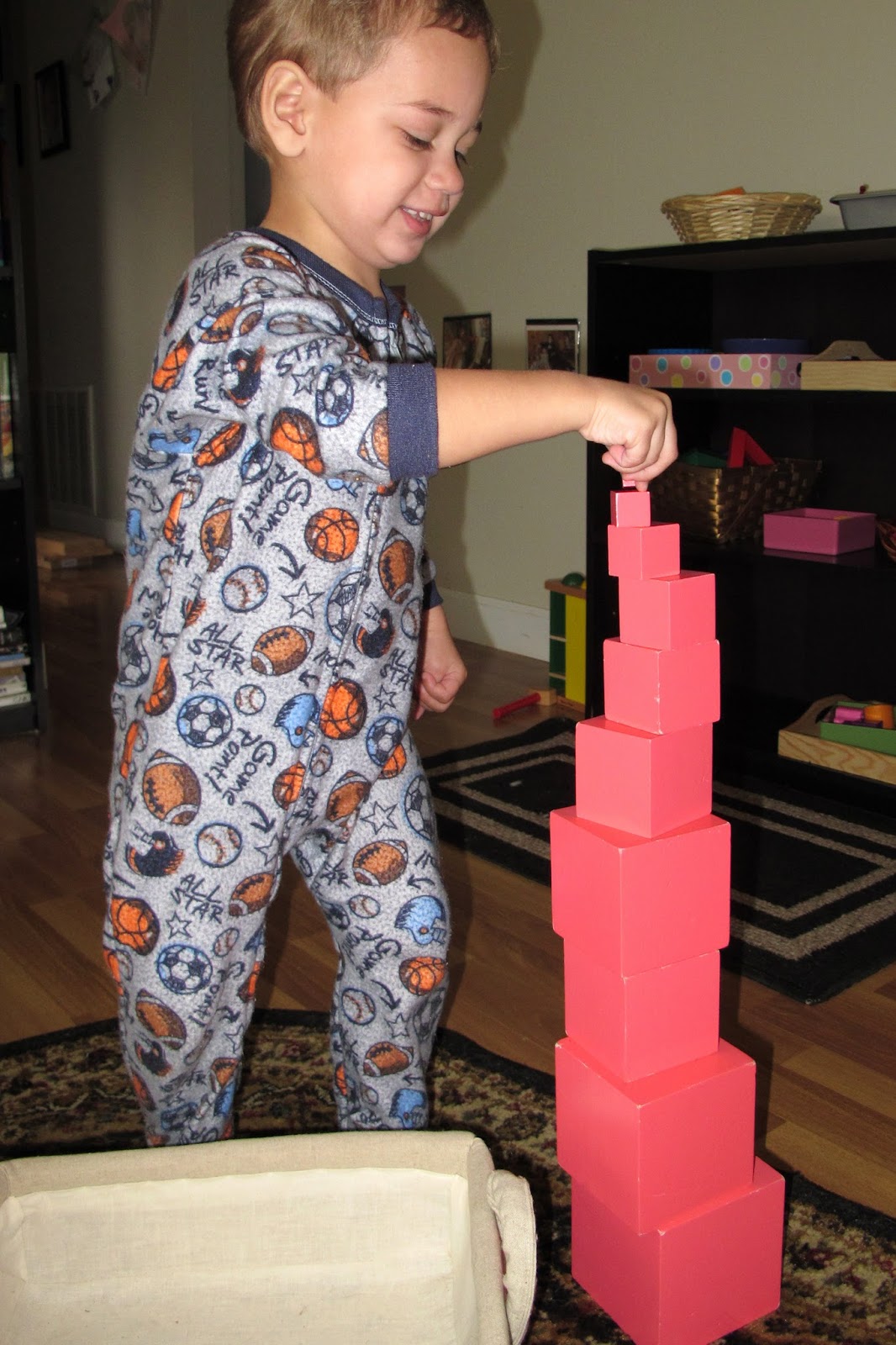
Though Tyler (now 27 mos old) did the Pink Tower a couple times correctly when I purchased it in the Spring, I felt that he didn't truly grasp the meaning of putting them in order by size. I then decided to have him use only every other block for greater changes of success and understanding of the sensorial concept. There was also a time that I took them out of rotation due to a lack of interest. Last week I brought all ten together again and he was very ready for them, nearly correct on the first try!
This video captures Tyler carrying the basket from the shelf, starting and completing the work, then returning it to the basket. He did the work several times and I didn't want to make the video too long, so returning it to the shelf isn't shown here. I can't get enough of the proud look on his face and the way he sits and examines the tower up and down to be sure it's correct! He typically says "small" "medium" and "big" though he skipped medium here. I'm not too concerned. :) You did it Ty!
I took this video of Tyler working with his cylinders several weeks ago to show those who are new to Montessori, or who are unfamilair with the philosophy, what is meant by the use of self-correcting materials. He hadn't used these cylinders more than ten times at this point so it took much longer for him to complete the work than it does now, though my point isn't to show how smart Ty is, but to demonstrate the focus and thought processes that a child must go through to complete a work. There's only one way to complete a Montessori work, which is easily apparent to the child after demonstrations of it. No adult intervention or correcting is needed which provides a sense of independence, and as a result, self-esteem. Especially in the "me do" toddler years, this holds great importance!
This is a work I developed and made myself inspired by the Montessori cylinders, so it is not official, though it follows all of the criteria as far as I'm aware. Tyler typically takes the cylinder work off of the shelf then returns it, but here he works mostly on the shelf. I love observing him at work and hope this is helpful to someone!