This is Part Two of my "Infant and Young Toddler Montessori" posts, covering activities and materials I used with Tyler (now 25 mos old) before I began this blog. If you missed Part One, it focused on the home and outdoor environment, and you can check it out
here! I'd like to mention that many of the photos in these posts were camera phone shots that I've tried my best to edit, but some still aren't the best quality. Hopefully that won't get in the way too much! This post also covers only what may be a bit off of the beaten path for some parents. The basics such as singing, talking to your baby, tummy time etc, aren't included here.
I'm going to start off saying that a couple of these materials are clearly choking hazards. Tyler was really good about not putting things in his mouth that he wasn't supposed to, but there were also times when I would give him a pacifier to help deter him. Close supervision was always used. Please know your child and how they may respond to small objects!
I should also note, as it has been asked quite a few times, that Tyler had plenty of the usual "toys", not just Montessori-inspired materials. He has always used toys and "materials" with the same excitement and doesn't seem to see a difference, but that's a whole other post I hope to write soon! I did start to weed out the passive battery operated toys once I learned more about Montessori and started to purchase durable, wooden toys that required thought, creativity and/or control of error whenever possible.

Some of Tyler's favorite things to play with were simple, inexpensive items. A basket of sea shells from the dollar store were a great sensory experience. I also buried several of them in his sandbox for him to find. Free carpet squares from Lowe's were also good sensory objects. I took two of each kind, every set of squares having very different textures and colors. When he was a bit older we used these in a matching game. I also purchased hardwood and heavy tile samples for about $.50 a piece. I chose different weights, wood colors and textures. With these materials he had the opportunity to notice differences between same objects, a key piece in Montessori's sensorial education!

Little tots just love to fill and dump as well as to handle small objects! These river rocks purchased at the dollar store paired with this (or any) container were just one of the ways we provided this necessary experience. The rocks varied in color and size as well which I appreciated. The rocks are currently stored away and will be brought out later for sorting by size and color when he's ready. A lot of bang for one buck!
Tyler's love for marbles goes way back! Here he is transferring marbles from a bowl to an ice cube tray, practicing that important pincer grasp. He wasn't quite ready to work on 1:1 correspondence yet, but I like that he was becoming familiar with the initial concept when I demonstrated it myself.
Sensory bottles were a huge hit with Tyler! Using child-sized disposable water bottles, I filled the bottles with various objects and solutions and glued the tops on! They encourage a lot of visual attention as well as the development of motor planning in order to make the contents move (by shaking and tipping).
The bottles from left to right:
Sand with light blue water, yellow water with yarn, teal water with dish soap, red water with glitter, vegetable oil and green water, clear water with coins.
Water with glitter, blue water with dish soap, water with beads, dry spaghetti (no water), water with sink and float objects, marbles and water.
The dry spaghetti in the last set of bottles was due to me accidentally poking a hole in the bottle, but it became one of Tyler's favorites. He loved to shake it and make noise, so I then made several dry bottles for him using pennies, rocks, marbles, screws and screws for loud bottles, and objects like q-tips and small puffballs for softer sounds. Again, working a bit of early sensorial discrimination!
In part one I talked about collecting items from nature to bring home and examine. We made several nature baskets this way, either from hikes or walks around the neighborhood. His favorite items to explore again and again were rocks, pine cones and pieces of bark.
Last year I created a post about all of the sensory play that I did with Tyler before I began blogging, which you can find
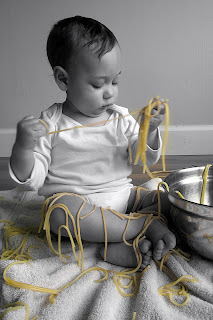
here.. The above is cooked spaghetti play which was one of our favorites. He made a fantastic mess! You can also dye the spaghetti by adding food coloring to the cooking water for more visual interest.
Sandbox play is probably a bit of a no-brainer, but it was, and still is, one of Tyler's favorite things to do. His sandbox time can now easily last 45 mins at a time. To mix it up you can use dry or wet sand. Dry is great for scooping and using funnels/wheels and wet of course great for learning to make sand castles!
I missed this one in my earlier sensory post. This is simply oatmeal in a dish bin with a few small cups for filling by hand and dumping. If the weather is nice and you don't feel like cleaning up the mess that infants and little toddlers with certainly make with these activities, bringing the activity outdoors makes life easier!
Though Ty sat independently quite early, it took me a long time to feel comfortable letting my little daredevil loose in the tub. To allow him the freedom of splashing and really experiencing the joys of water play , I often suited-up and got in the tub with him. It was a lot of fun for both of us!
Tyler's interest in books started really early, so we followed his lead and read to him constantly.
At three months old he had already found one of his all-time favorite books: "Fox in Socks" by Dr. Seuss. What a fabulous tongue twister!
Big books with colorful illustrations really grab an infant's attention and Ty was no different. As a newborn he was especially intrigued by Tana Hoban's simple black and white books, which are easiest for young, developing eyes to focus on.
Introducing Tyler to our local library at a young age was very important to me. We would visit for story and play time for socialization, as well as to let Tyler browse the board books. The library has been a wonderful way to add to our literacy learning, as well as great for checking out musical CD's of all types.
My husband and I are both musical and come from musical families, so this was also an important area for us to expose Tyler to as a baby. He showed a great love for music as a newborn, instantly calming whenever I sung certain songs (and this is still true!). He learned to keep beat at an early age after we constantly kept the beat with our feet on the floor, clapping hands or patting his back. We played a wide variety of music for him, staying away from the harder stuff (metal, heavy rap, hardcore punk etc.) which studies have shown can disorganize an infant's brain.
Following his musical lead, we allowed Ty to play my husbands guitar with supervision. He quickly learned that the guitar was a very respected item that we should be gentle with. He wanted to learn to use a pick to play as Daddy did, so we helped him with his endeavor until just before his first birthday when he mastered it himself. Being able to use an instrument in the correct way has been a great source of pride!
Along with the guitar, Tyler had several easy to use instruments such as a tambourine and drum to bang on, various shakers, and an infant piano.
I had forgotten about this box until I found the photo! Here I took a shipping box and cut a few holes in the side. Inside I put objects that could be removed by reaching in and grabbing through the hole, and objects that were too big for the holes that would require lifting from the top of the box. It was a bit of a mental challenge for Tyler which he enjoyed! It also served a bit as a mystery box as sometimes he would reach in without looking and feel around until he found something to grab hold of. I imagine that once he had it in his hand, his brain was working to figure out what the object may be, much like the Montessori "Mystery Bag" used with older children !

Though a single shape puzzle would be ideal, this three piece puzzle with a large circle, triangle and square worked well for Tyler. As expected, he didn't master the triangle until later, but he was always very happy to be able to fit the other two! Normally he wouldn't even bother to take the triangle out, I suppose because he knew it was too difficult for him at the time.
Going back now it's so easy to forget how simple but important our little games were! This was simply a bowl of balls that I kept on the floor. He would throw the balls around the room one by one and I would retrieve them and we would start again or move on. At times we would gather the balls together, putting them back in the bowl one by one. This was a good start for learning that all objects have their place!
A low mirror is a very Montessori concept for infants. It allows them to see themselves and provides visual stimulation. I used an old door mirror that we already had. Though the frame had broken off, I used thick, clear to soften the edges. Once Tyler began to walk, I didn't feel that the mirror was safe or needed anymore and it was removed. You can find quality infant mirrors online, though they are typically quite pricey.
Tyler sought independence in areas such as self-feeding at a rather young age. Though it was quite messy, we allowed and encouraged this.
Tyler also enjoyed (and still does) brushing his own teeth. Though he wasn't hugely successful at first, he saw us brushing and wanted to do this on his own. We delighted in his "big boy" independent nature!
One of Tyler's big interests and sensitive periods, other than the opening and closing phase I spoke of in Part One, was putting lids on containers. I noticed this through close observation of his activities. I then responded by giving him every lidded pot and pan I could find and left them in an out of the way area of our kitchen for him to practice whenever he liked.
I also gave him out tea kettle for practicing with. His desire was so strong. It was very fufilling to allow him every opportunity I could find.
As his skills improved, I taped several containers to a baking pan so that he could place the right lid on each without needing to use his other hand to steady and hold the container (a skill that was too advanced for him at that point). Though there were times when he enjoyed ripping the containers from the pan, requiring me to tape everything down again, he got a lot of use from this work.
A great store-bought toy for satisfying this desire was a busy box. Though he was too young to open many of the doors himself, he greatly enjoyed pushing them down! This also taught object permanence.
When he was about 14 months old, Tyler saw my husband and I raking leaves and wished, as most children do, to be just like us. Though he managed the adult-sized rake better than we imagined, it certainly wasn't ideal, especially because we wanted to use it! The clear answer was to buy Tyler his own child-sized metal rake, found at Lowe's for only about $8.
Helping with the dishwasher was another important imitation activity that Tyler enjoyed. We simply removed any knives or easily breakable items and let him take out, and attempt to replace, anything he pleased. Pushing the drawers in and out was also a big hit when going through his opening and closing period!
Making his mark through finger painting was started and enjoyed by Tyler early on as well. I tended to spread an old sheet onto the floor or take him outside so there were very few limits to his joyful creating!
And lastly, though this really came first, I think Tyler's most important "activity" was as a newborn. Tyler was SGA, or "Small for Gestational Age" due to a very scary complication from week 25 of my pregnancy on, until his birth. When he was born, Tyler didn't understand how to nurse, so almost constant skin-to-skin was used between Tyler and I to help encourage him, especially as he was so thin. Though Tyler got the hang of nursing after a couple extra days in the hospital and help from a fantastic LLLC, I continued to provide Tyler skin-to-skin contact for at least an hour every day for over a month, as did my husband at times.
I firmly believe that the comfort and security of skin-to-skin is one of the reasons that Tyler had the ability later on to explore his world so freely and to eagerly take on the world. With a huge, loving base, a child is more secure and able to learn. This security can certainly be obtained through other ways such as cuddling, responding to cues, baby wearing, co-sleeping and nursing if you're able and choose to do so, but I really believe in importance of skin-to-skin is for nurturing human development and secure attachment. Even if your child is a few months old, the benefits of this kind of bonding are there for the taking!
For more information on Montessori-based infant activities, the following links may be helpful: